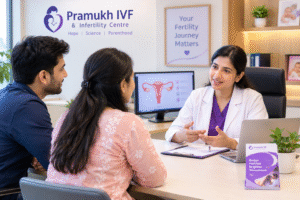


For many couples, planning a family is an important milestone. However, when pregnancy does not happen as expected, it can lead to questions, uncertainty and emotional stress.
Some couples wonder whether they should continue trying naturally, while others are unsure when to seek medical advice. The important thing to understand is that you do not always need to wait for a full year before consulting a fertility specialist. Your age, menstrual cycle, medical history and reproductive health can all influence when an evaluation is appropriate.
A fertility specialist can help identify potential factors affecting conception, recommend suitable investigations and explain the options available for your individual situation.
At Pramukh IVF, we believe that informed decisions and timely medical guidance are important steps in a couple’s fertility journey.
1. You Have Been Trying to Conceive Without Success
One of the most common reasons to consult a fertility specialist is difficulty conceiving despite regular, unprotected sexual intercourse.
General medical guidance recommends a fertility evaluation in the following situations:
- Under 35 years: Consult a specialist if pregnancy has not occurred after 12 months of trying.
- Age 35–40 years: Seek an evaluation after 6 months of trying without success.
- Over 40 years: Consider seeking medical advice promptly rather than waiting several months.
These are general guidelines, not strict rules for every individual. If you have a known medical condition that may affect fertility, an earlier consultation may be appropriate.
Timely evaluation can help couples understand their reproductive health and decide on the next steps with their doctor.
2. Your Menstrual Cycles Are Irregular or Unpredictable
Menstrual cycle patterns can provide useful information about reproductive health.
If your periods are frequently irregular, very infrequent or absent, it may indicate that ovulation is not occurring regularly. Ovulation is the process in which an ovary releases an egg, and it plays an important role in natural conception.
Possible underlying factors include:
- Polycystic ovary syndrome (PCOS)
- Thyroid disorders
- Certain hormonal imbalances
- Significant weight changes or other medical conditions
Irregular periods do not automatically mean that you cannot conceive. However, if you are planning a pregnancy, discussing these changes with a gynaecologist or fertility specialist can help determine whether further evaluation is needed.
3. You Have Been Diagnosed With PCOS or Endometriosis
Certain health conditions can affect fertility and may justify an earlier consultation.
PCOS and fertility
PCOS can affect ovulation, making it more difficult for some women to conceive. A doctor may assess menstrual history, relevant symptoms and other clinical findings before recommending an individualised treatment plan.
Endometriosis and fertility
Endometriosis occurs when tissue similar to the lining of the uterus grows outside the uterus. Depending on its location and severity, it may affect reproductive health.
If you have been diagnosed with either condition and are planning a pregnancy, discuss your fertility goals with your doctor. An appropriate evaluation can help determine whether observation, medical management or fertility treatment should be considered.
4. There May Be a Male Fertility Factor
Fertility challenges do not affect women alone. Male reproductive factors can also contribute to difficulty conceiving.
Potential factors include:
- Low sperm concentration or reduced sperm movement
- Certain hormonal or testicular conditions
- Previous reproductive surgery or injury
- Sexual or ejaculation difficulties
- A history of treatments or medical conditions that may affect sperm production
A semen analysis is commonly used as part of the initial evaluation of male fertility. Depending on the findings, additional tests or consultation with an andrologist or urologist may be recommended.
Both partners should be considered during a fertility evaluation. Assessing only one partner may overlook important information that could help guide care.
5. You Have a History of Reproductive or Medical Conditions
Some medical histories can make an earlier fertility assessment worthwhile, even if you have not been trying to conceive for very long.
Examples include:
- Previous pelvic infections or suspected damage to the fallopian tubes
- Known uterine or reproductive tract conditions
- Previous treatment for cancer, including chemotherapy or radiation
- A history of reproductive surgery
- Known or suspected male-factor infertility
- Recurrent pregnancy loss
Not everyone with these histories will experience infertility. The purpose of an early consultation is to understand individual risk factors and determine whether any investigations are appropriate.
6. You Are Concerned About Age and Fertility
Age is an important factor in female fertility. As a woman gets older, both the number and quality of eggs generally decline, with the decline becoming more significant during the mid-to-late 30s.
Age does not determine an individual’s fertility outcome on its own. However, it can influence how quickly an evaluation should begin and which options a specialist may discuss.
If you are in your late 30s or 40s and planning a pregnancy, consider discussing your reproductive goals with a fertility specialist rather than relying on symptoms alone.
A fertility assessment may help clarify your situation, but no single test can guarantee whether or when pregnancy will occur.
7. You Have Experienced Previous Unsuccessful Fertility Treatment
If you have previously undergone fertility treatment without achieving pregnancy, a follow-up consultation may help you understand what to consider next.
Depending on your medical history, your doctor may review:
- Previous test results and treatment records
- The response to any earlier medication or procedures
- Relevant male and female fertility factors
- Whether additional investigations may be useful
- The potential benefits, limitations and risks of further treatment
An unsuccessful treatment cycle does not automatically mean that future treatment will fail. Equally, no treatment can guarantee pregnancy. The next step should be based on a careful review of your individual circumstances.
8. What Happens During Your First Fertility Consultation?
Many couples delay seeking help because they are uncertain about what a fertility appointment involves.
The first consultation generally begins with a discussion of your medical and reproductive history. Your doctor may ask about:
- How long you have been trying to conceive
- Menstrual cycle patterns and previous pregnancies
- Previous medical conditions, operations and treatments
- Current medications and relevant lifestyle factors
- Your partner’s reproductive and medical history
Depending on the findings, your doctor may recommend investigations such as:
For women:
- Relevant blood tests, including selected hormone tests when indicated
- Pelvic ultrasound
- Assessment of ovulation where appropriate
- Evaluation of the uterus and fallopian tubes when indicated
For men:
- Semen analysis
- A medical examination or hormone tests when clinically appropriate
- Further evaluation if initial findings suggest a specific concern
Not every patient needs every test. The investigation plan should be tailored to the couple’s history and clinical findings.
9. What Fertility Treatment Options May Be Available?
The appropriate treatment depends on the cause of the fertility difficulty, the age of the individuals involved, previous treatment and other clinical factors.
Options may include:
Lifestyle and medical management
Some couples may benefit from addressing relevant health conditions, reviewing medications or receiving treatment to support ovulation.
Ovulation induction
When ovulation is irregular or absent, a doctor may recommend medication to help stimulate ovulation, depending on the diagnosis.
Intrauterine insemination (IUI)
IUI involves placing prepared sperm into the uterus around the time of ovulation. It may be appropriate in selected clinical situations.
In vitro fertilisation (IVF)
IVF involves retrieving eggs, fertilising them with sperm in a laboratory and transferring an embryo into the uterus. It may be considered for several fertility-related conditions.
Intracytoplasmic sperm injection (ICSI)
ICSI is a laboratory technique in which a single sperm is injected directly into an egg. It may be recommended in selected cases, including certain male-factor fertility situations.
Not every couple needs IVF or ICSI. A qualified fertility specialist can explain the potential benefits, limitations, costs and risks of the options relevant to your situation.
10. Why Early Fertility Evaluation Can Matter
Seeking medical advice at the appropriate time can help couples:
- Understand potential reasons for difficulty conceiving
- Identify conditions that may need attention
- Avoid unnecessary delays in evaluation
- Explore treatment options based on their medical history
- Make informed decisions together
Early consultation does not mean that you will necessarily need fertility treatment. In many cases, the first step is simply to understand your reproductive health and receive appropriate guidance.
Frequently Asked Questions (FAQs)
1. When should a couple visit a fertility specialist?
Generally, an evaluation is recommended after 12 months of trying if the female partner is under 35, and after 6 months if she is 35–40. People over 40 or those with known fertility-related concerns should seek advice sooner.
2. Can you have fertility problems without any symptoms?
Yes. Some fertility-related conditions do not cause obvious symptoms. Difficulty conceiving may be the first indication that an evaluation is needed.
3. Should both partners undergo fertility testing?
Both partners should be considered. Depending on their history, evaluation may include an assessment of ovulation and reproductive anatomy, along with semen analysis.
4. Does an irregular period mean infertility?
No. Irregular periods can have several causes and do not automatically mean infertility. However, they may indicate irregular ovulation and should be discussed with a healthcare professional when pregnancy is planned.
5. Does visiting a fertility specialist mean IVF is necessary?
No. Treatment depends on the underlying factors. Some couples may conceive naturally, while others may benefit from medical management, IUI, IVF or another individualised approach.
6. Can a fertility test guarantee pregnancy?
No. Fertility tests provide information about specific aspects of reproductive health, but they cannot guarantee natural conception or the outcome of fertility treatment.
7. What should I bring to my first fertility appointment?
Bring previous investigation reports, relevant medical records, a list of current medications and details of previous treatments, if applicable. Both partners attending together can help the specialist understand the complete history.
Take the Next Step With Pramukh IVF
If you and your partner have been trying to conceive without success, you do not have to navigate every question alone.
A fertility consultation can help you understand your reproductive health, identify whether further investigations are needed and explore the options that may be appropriate for you.
Pramukh IVF & Infertility Centre is committed to helping couples make informed decisions through individualised fertility assessment and guidance.
Contact Pramukh IVF to enquire about a fertility consultation and learn about the next steps for your situation.
Medical disclaimer: This article is intended for educational purposes only and does not replace an individual medical consultation. Fertility evaluation and treatment recommendations should be made by a qualified healthcare professional based on the patient’s clinical history and examination.
References
- American College of Obstetricians and Gynecologists (ACOG) — Evaluating Infertility: https://www.acog.org/womens-health/faqs/evaluating-infertility
- American Society for Reproductive Medicine (ASRM) — Fertility Evaluation of Infertile Women: https://www.asrm.org/practice-guidance/practice-committee-documents/fertility-evaluation-of-infertile-women-a-committee-opinion-2021/